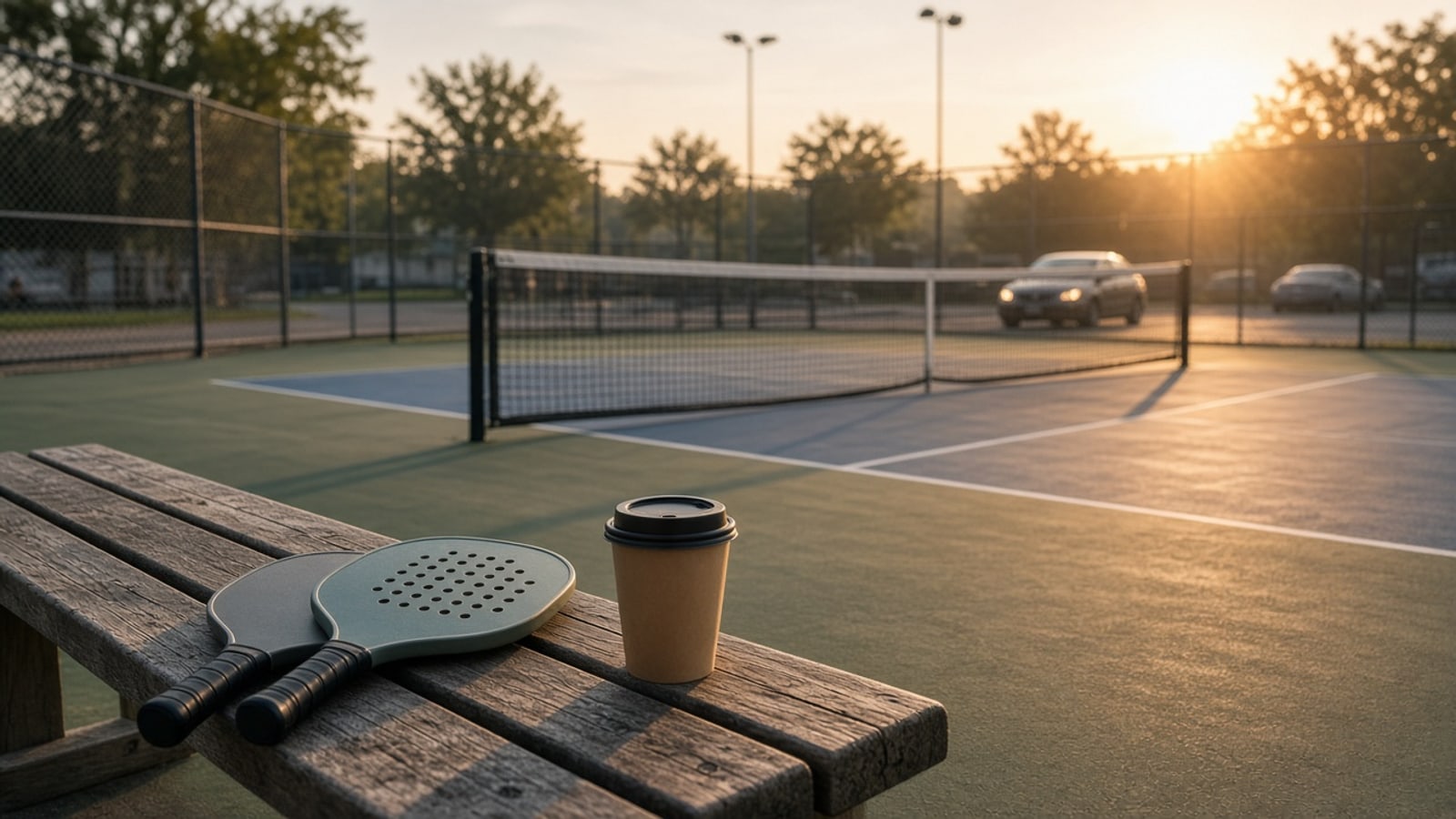
The Sunday game starts at nine, which means my parents are on the court at 8:45 and I am there at 8:52 with a coffee I am not supposed to bring because my mother says it makes me sluggish. It is a small club near their house in Denver, two indoor courts, and the same eight people every week, all of them between sixty and seventy-two except me.
My father warms up for exactly four minutes. He walks the court, does a few arm circles, and then stands at the kitchen line and hits dinks with my mother while I am still tying my shoes. My mother has better hands than I do and knows it. She does not say so, because she does not need to. The net game came from years of doubles, which is not the part my coaching background helps with.
Three games, one partner switch per game, then breakfast. That is the whole tradition, three years running, and the best appointment on my calendar.
The backhand
My father has a backhand that would make a tennis coach weep. He hits it from the wrist, he does not turn his shoulders, and the face is open at contact. It is, by every technical measure I was trained to apply, wrong.
It also lands where he wants it to land, mostly. It is a soft, weird, floating ball that dies in the kitchen and cannot be attacked because it has no pace on it. He has beaten me three of the last five games with that shot, and the first time it happened I wanted to explain the grip. The second time, I wanted to explain the shoulder turn. The third time, I just wanted another game.
That is the whole argument for this sport in one family, and it took me a while to learn it. My instinct, after fifteen years of tennis and six years of coaching, is to fix things. A wrong grip is a project. A weak backhand is a project. But my father is not a project. He is a man in his sixties who has found a shot that works for him, and the reason he wins with it is that it is his.
I made a rule for the family game, and I have kept it. I do not coach my father on his backhand. Not in the car, not at breakfast, not in a text the next day. If he asks, I answer in one sentence and then change the subject. He has asked twice in three years. Both times he listened politely and then did it his way, and both times he kept winning with it.
What tennis culture got wrong
I grew up in a sport where the score was always the story. Tennis taught me discipline, footwork, and how to compete, and I am grateful for all of it. It also taught me to measure every session by whether I got better, and to see a family member's odd shot as a flaw in an otherwise decent game.
Pickleball does not require that frame. The court is small, the ball is slow, and the game is short enough that a 32-year-old and a 67-year-old can have a genuinely close match. My father cannot cover the whole court, and I can. I have a bigger serve, and he has a better third shot. The advantages do not cancel out. They make the game interesting.
The other thing the family game has taught me is that the score should be close enough that nobody has to manage it. I do not run harder against my parents to make it feel competitive, and I do not ease up either. I play the game I would play against anyone, and they play the game they play against me, and the results are honest. Three of the last five is honest. The two I won were honest too.
If you are younger and thinking about joining a group of older players, I wrote about the etiquette of that in how to be the youngest player in the group. The family version has one extra rule, which is that you cannot leave the group. You will see these people at Thanksgiving.
The rules nobody says out loud
There are four rules for the Sunday game, and none of them are written down.
Partners switch every game. That is not fairness, it is survival, because if my father and I are partners for three games in a row, the car ride home is quiet in a specific way.
The score stays honest, including the games I lose. My mother keeps it in her head and announces it like a weather report.
The games stay short enough that everyone wants another. A blowout is not fun for anyone, and a 12-10 game is a story for the rest of the week.
And nobody coaches. That rule is mostly for me.
Four rules, no laminated sheet, no meeting. The family game works because everyone has already agreed to the same small things.
The standing appointment
What I did not expect from the Sunday game was that it would become the thing my family does. Not the holiday dinner, not the phone calls, not the group chat. The Sunday game. My mother keeps the standing time on her calendar like a doctor's appointment. My father starts talking about the previous week's games on Friday. I have rearranged league games to protect it, and I am the one with the league.
The game also gave the family a shared vocabulary that has nothing to do with tennis. My mother says "that was a kitchen ball" at dinner. My father says "I got lucky" when he did not get lucky at all. Talk turns to partners and rotations and the time the fourth player did not show and the game became cutthroat. None of it is dramatic. It is a small, repeated thing, which is what families actually run on.
If you have a parent who is willing, invite them to be a fourth. Not to a lesson, not to a tournament, not to a fitness plan. To a game with a stop for breakfast afterward. Keep it short, keep the score honest, and do not coach them unless they ask. Dottie Frasier has good advice about the first session in the new couple at 7:25, and most of it applies to a parent.
My father beat me again on Sunday, 11-9, with three backhand dinks in the last game that I still cannot explain. I drove home and told my wife about it, and she said, "You know he is going to do that every week now." She is right. I am already looking forward to it.