The sign-up sheet at the rec center is a better document than most constitutions. It tells you who arrives early, who wants the good court, who will quietly delete their name when the wind picks up, and who is willing to play with anyone. I signed up third on Tuesday, which is how I ended up with a partner who calls every ball out before it lands, including his own.
Here is the short version: put your name at the bottom when you arrive, do not move anyone else's name, and tell the organizer before you leave early. On a busy Saturday, the first six names play the first two games, so arriving at 7:25 instead of 7:10 can mean a 20-minute wait. Three rules, one clipboard, and a club that feels less like a workplace.
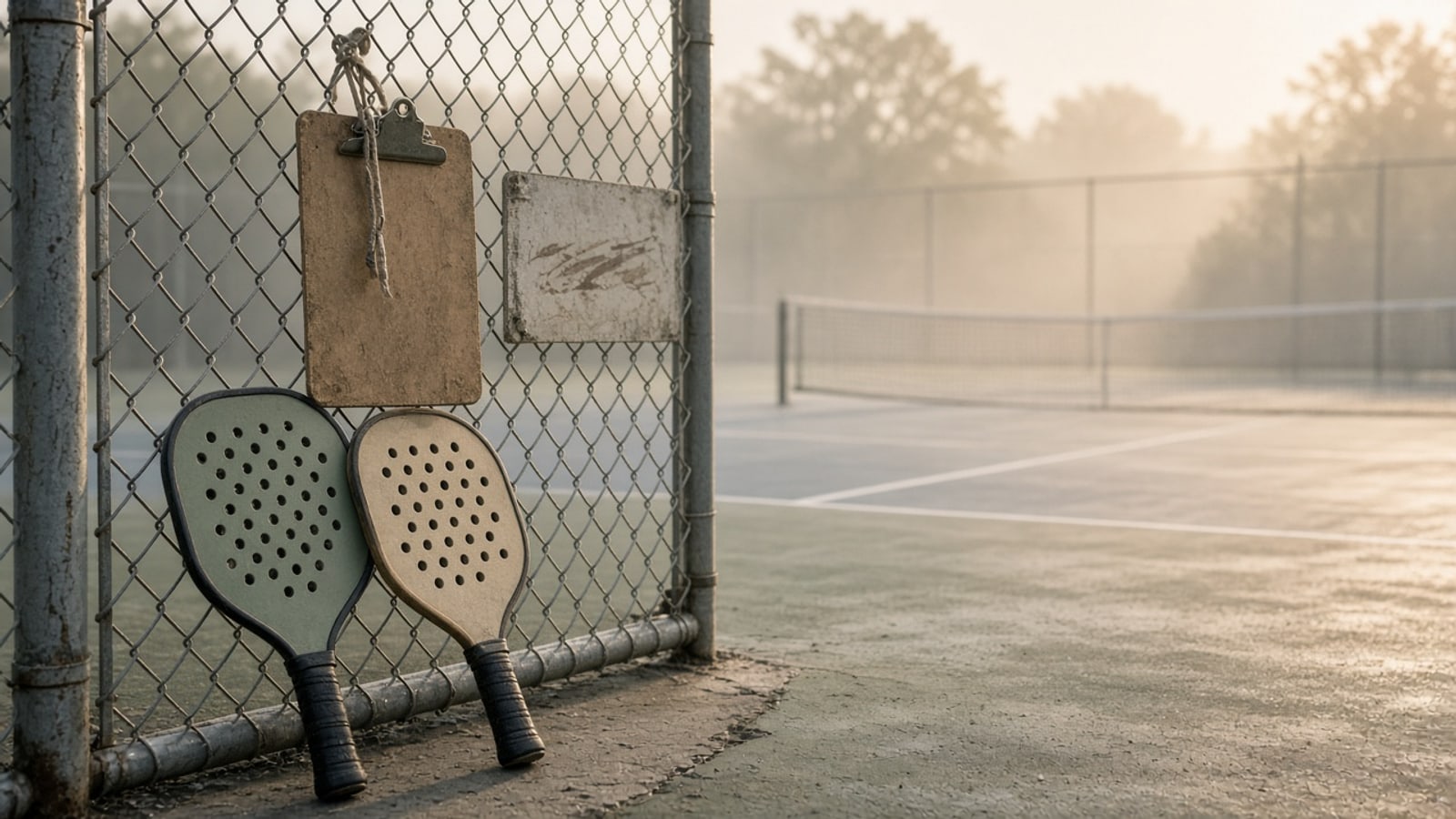
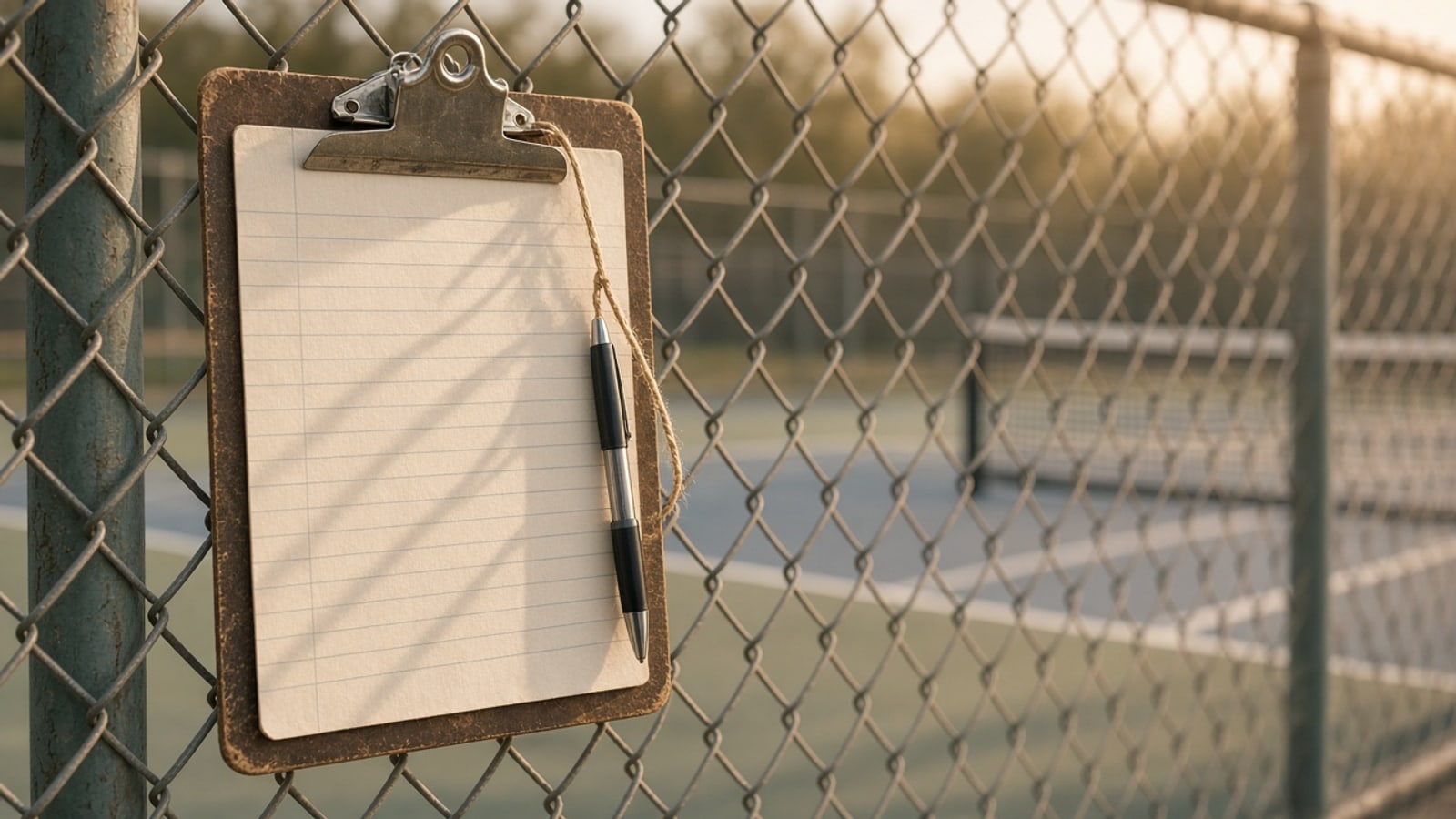
I taught American history for thirty-one years, and I can tell you that the founding documents get all the attention while the real governance happens in the minutes nobody reads. At a pickleball club, the real governance is a clipboard hanging from a fence by a shoelace.
What the sheet knows
A sign-up sheet has four columns at most: name, time, maybe a partner, maybe a note. Within those columns is the entire social order of the club.
There are three versions of the document at the clubs I know. The paper sheet on a clipboard, which is the original and still the most honest. The app, which is the same document with worse handwriting and a notification. The paddle stack, which is the sheet turned into physical objects and is, in its way, the clearest of the three. A stack of paddles does not argue. It tells you exactly where you are in line, and everyone can see it from across the court.
The first six names play the first two games. The names in the middle are the regulars who arrive at a reasonable hour and expect a reasonable wait. The names at the bottom are either new, late, or polite to a fault. The person who writes their name first and then stands by the cooler talking instead of warming up is making a statement about rank, whether they know it or not.
I am not judging. I am observing. I am, after all, a historian.
The name you cross off, and the name you never do
There are two kinds of deletions.
The first is honest: you put your name down, your knee starts talking, you tell the organizer and go home. That is not a deletion. That is a person managing their body.
The second kind is the quiet one late in the afternoon, when someone erases a name that was ahead of theirs because they decided the person had already played enough. That is politics, and it is the kind of politics that makes a club feel like a workplace.
The rule I would engrave on every clipboard: do not move another person's name. If there is a mistake, ask. If there is a dispute, ask the organizer. The sheet belongs to the group, not to the fastest hand with the eraser.
Rules I would add to the sheet
If I ran the club, and I do not, the sheet would have a small printed footer. It would say:
- Put your name at the bottom when you arrive.
- Warm up before your first game, not during it.
- Tell the organizer if you are leaving early.
- Play with the person the sheet gives you.
- If the wait is longer than the game, tell the organizer.
That fifth rule is the one nobody writes down and everybody feels. On a busy Saturday, the four courts run a rotation of about twenty minutes. If you are waiting thirty, the rotation is broken, and it is the organizer's job to fix it, not the newest player's job to complain.
The two-minute rule for a new name
If a new player writes their name on the sheet, the most useful thing an organizer can do costs two minutes. Say the rotation out loud, give them a number, and tell them roughly when they will play.
"After these two games. About twenty minutes. You are with Art and me first."
That sentence does more for retention than a free clinic. A new player who knows where they are in the line can relax, warm up, and watch the games. A new player who does not know stands at the edge of the fence, wonders whether they have been forgotten, and leaves after forty minutes.
I have seen it both ways at the same park, on consecutive Saturdays, with the same courts and the same weather. The difference was not the quality of the play. It was whether someone took two minutes with the clipboard.
The last line
At the bottom of the sheet, under the last name, there is usually a blank space. That space is the best part of the document. It is where the next person writes their name and joins the club.
I have watched a man in his seventies write his name in that space on a Saturday morning, look around at the courts, and decide whether he belonged. He did. He played three games and came back the next week with a better paddle and a worse serve, which is the correct order of operations.
The sheet is not the club. But it is the club's memory, and if you want to know what a group actually believes, do not read the mission statement. Read the clipboard.
Dottie, who runs a club of sixty and therefore knows more about this than I do, wrote about the first forty minutes with a new player. And if you are the person whose knees are the reason you study the rotation carefully, Tomás has the warm-up in the warm-up I do at fifty-eight.