The elevator at the hospital takes forty seconds to reach the parking garage, and on Tuesdays I use all forty of them to make a decision. Am I going to the 6:30 game, or am I going home? For the first year I played, I made that decision in the car, which meant I made it while already driving, which meant the decision was always yes and the preparation was always none.
Now I decide in the elevator and I use the hour. Not for drills. For the transition. What I have learned is that the hour between a hospital operations day and a church gym session is part of the warm-up, and it is the part I used to skip.
The elevator decision
My Tuesdays start with a 7:30 meeting and end with a stack of approvals that never quite closes. By 5:15 I am tired in the specific way that comes from making decisions for other people all day. That is not the same as being tired in the body, but it feels like it, and it makes a game look like one more obligation.
The elevator decision is not whether I feel like playing. The answer to that is usually no, and the answer is usually wrong. The decision is whether I have the hour. If I have the hour, I play. If I do not, I go home without guilt, because a rushed session is worse than no session. That is the rule, and it took me a year to accept it.
The snack in the car
I eat something small at about 5:30, and I eat it in the car because that is where the time is. An apple and a handful of nuts is my usual. Sometimes it is a banana and a spoon of peanut butter eaten standing at the kitchen counter while I fill a water bottle.
The rule I follow is boring and I follow it because I learned the hard way. Small, familiar, and about an hour before play. I tried a full dinner before an evening session once, and the first game was a lesson in humility and digestion. I have also tried playing with nothing in me, which is worse: the legs are fine for two games and then the third one is a rumor.
I do not have a formula for this and I do not believe anyone does. What I have is a note on my phone that says what worked twice and what failed once. The failure is more useful than the success. If you are going to experiment, do it on a night when the game does not matter.
The ten minutes
At the gym, I do ten minutes before the first point. Walking, arm circles, ten slow squats, and a few easy dinks with whoever is there early. That is it. It is not a program, and it is not trying to be. Tomás Herrera wrote the eight-minute version in the warm-up I do at fifty-eight, and his is better than mine for the body.
My ten minutes are for the head. I leave my phone in the bag, not on the bench. I stop thinking about the approval queue and start looking at the ball. The first twenty dinks are how I know whether I am actually at the gym or just standing in it.
There is a moment, usually about seven minutes in, when the day lets go. I cannot force it, and I have stopped trying to. What I can do is give it the room to happen. A rushed arrival does not have that room. A rushed arrival puts me on court with a tight grip and a mind somewhere else, and my game is not built to overcome that.
The Tuesday I played angry
One Tuesday in March, a meeting went badly at 4:45 and I got to the gym at 6:25 and went straight into a game. I played badly, but the way I played badly was the interesting part. I was swinging hard at balls I could not reach, I was short with my partner, and I did not enjoy a single point.
Afterward, one of the regulars, a retired teacher named Carole, said, "You were somewhere else tonight." She was right. I had brought the meeting with me. It was the only time I can remember snapping at a partner in four years, and I apologized, and she was gracious about it.
The lesson was not about pickleball. It was that the game does the job I need it to do, which is to separate me from the workday, and it cannot do that if I walk in carrying the workday. Ten minutes of dinks is not enough to put down a bad meeting. The elevator decision has to include the decision to stop rehearsing it.
Now if the day has been very bad, I drive home instead. The game is not a debt I owe. It is a thing I do because it works. On those nights it does not work, and I have learned that the hard way.
The drive home
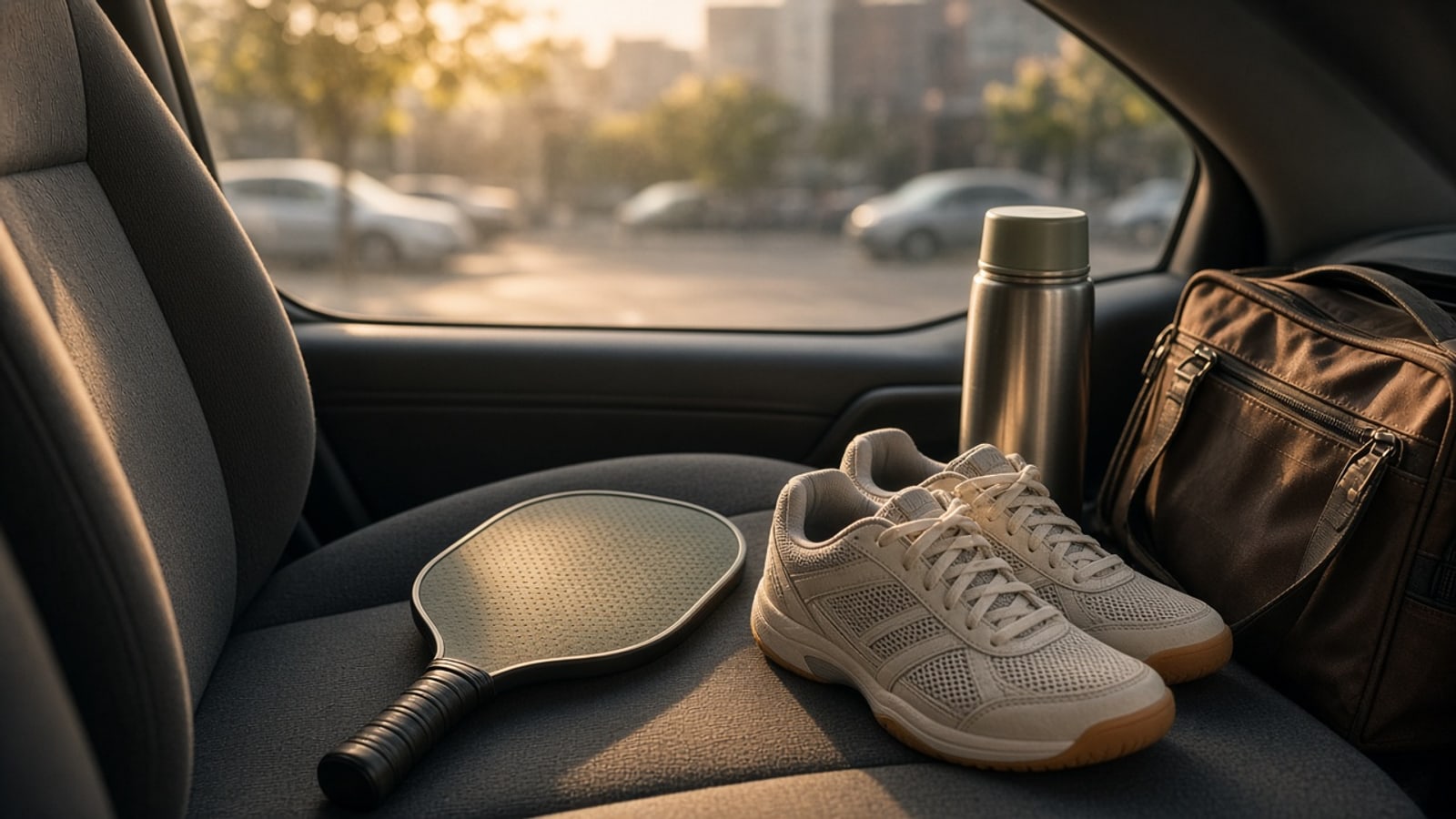
I leave the gym a little after eight and I am home by half past, and the drive home is the part I plan. Water on the seat next to me, not in the bag. A banana or an egg when I get in, because a late dinner is a bad idea and skipping it is worse. If you play after work, the car is where the routine actually happens. And no decisions about tomorrow, because the version of me at 8:30 makes ambitious plans that the version of me at 6:15 does not keep.
Wednesday is a walk, not a game. I wrote about that pattern in Tomás Herrera's piece on the morning after three hours of pickleball. My session is not three hours, but the principle holds. The day after is a payment.
Thursday is the same routine: elevator, snack, ten minutes, game. By the time I am sixty I will probably have played a thousand of these evenings, and the routine will look like superstition to anyone watching. It is not. It is the difference between a session I recover from and a session I regret, and it is built out of things that cost nothing except the willingness to leave work at 5:15.
The elevator decision takes forty seconds. It is the most important forty seconds of my pickleball week, and I made it on the way up, which means I made it before the exhaustion had a chance to vote.